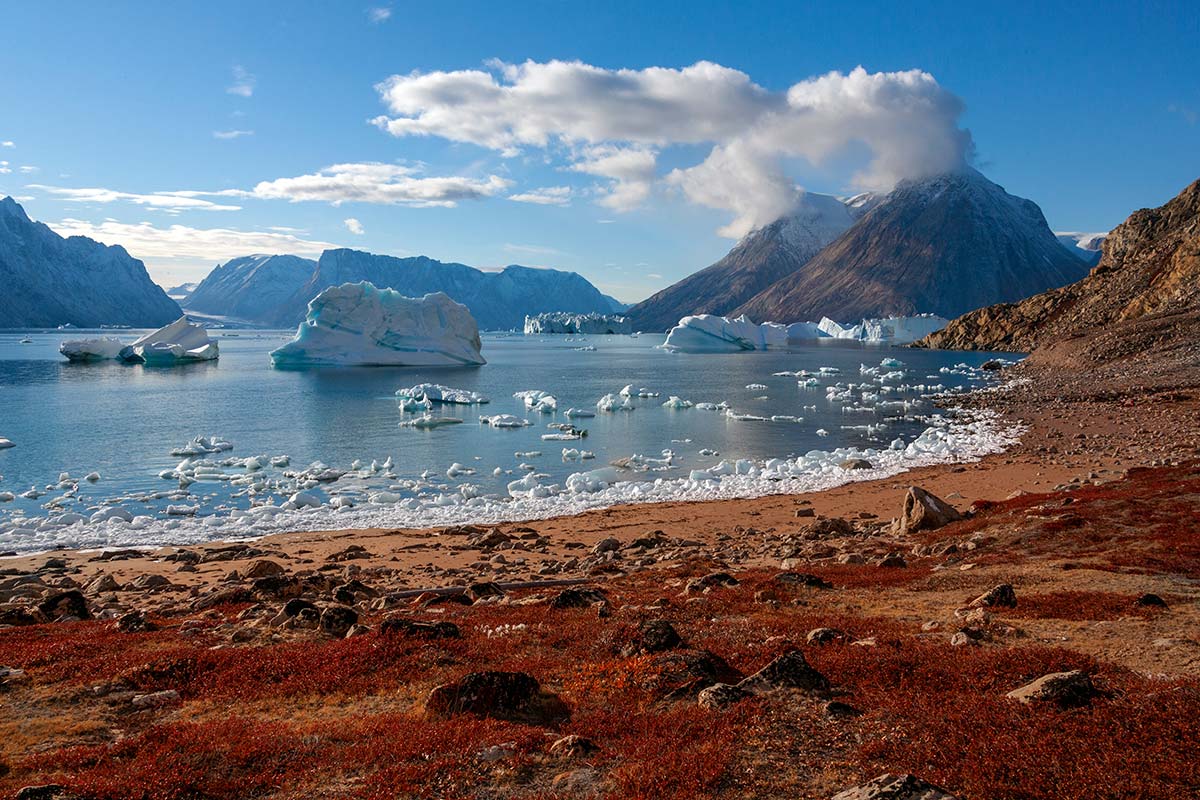
Jan Mayen
Norway’s Only Active Volcano
At the midpoint between Iceland, Svalbard, and Greenland lies the enigmatic volcanic island of Jan Mayen, a lonely rock in the middle of the Arctic Ocean. This volcanic island, hosting Norway’s only active volcano, is an incredible sight and a rare gem for any Arctic explorer. Even more isolated and seldom visited than Svalbard, this island has fascinated travelers for centuries, not only because of its isolation, but also due to the almost perpetual clouds and fog that hover almost permanently above it. Beerenberg, the summit of the volcano and the highest point of the island, reaches 2,277 meters, making it one of Norway’s 300 mountains over 2000m.
The volcanic origin of the landscape is visible all over with cinder cones, lava flows, and ash covering the lowlands, and the Fuji-esque peak of Beerenberg looming above.
Area of Jan Mayen
- 373 km²
Population of Jan Mayen
- 18 people
Map of Jan Mayen
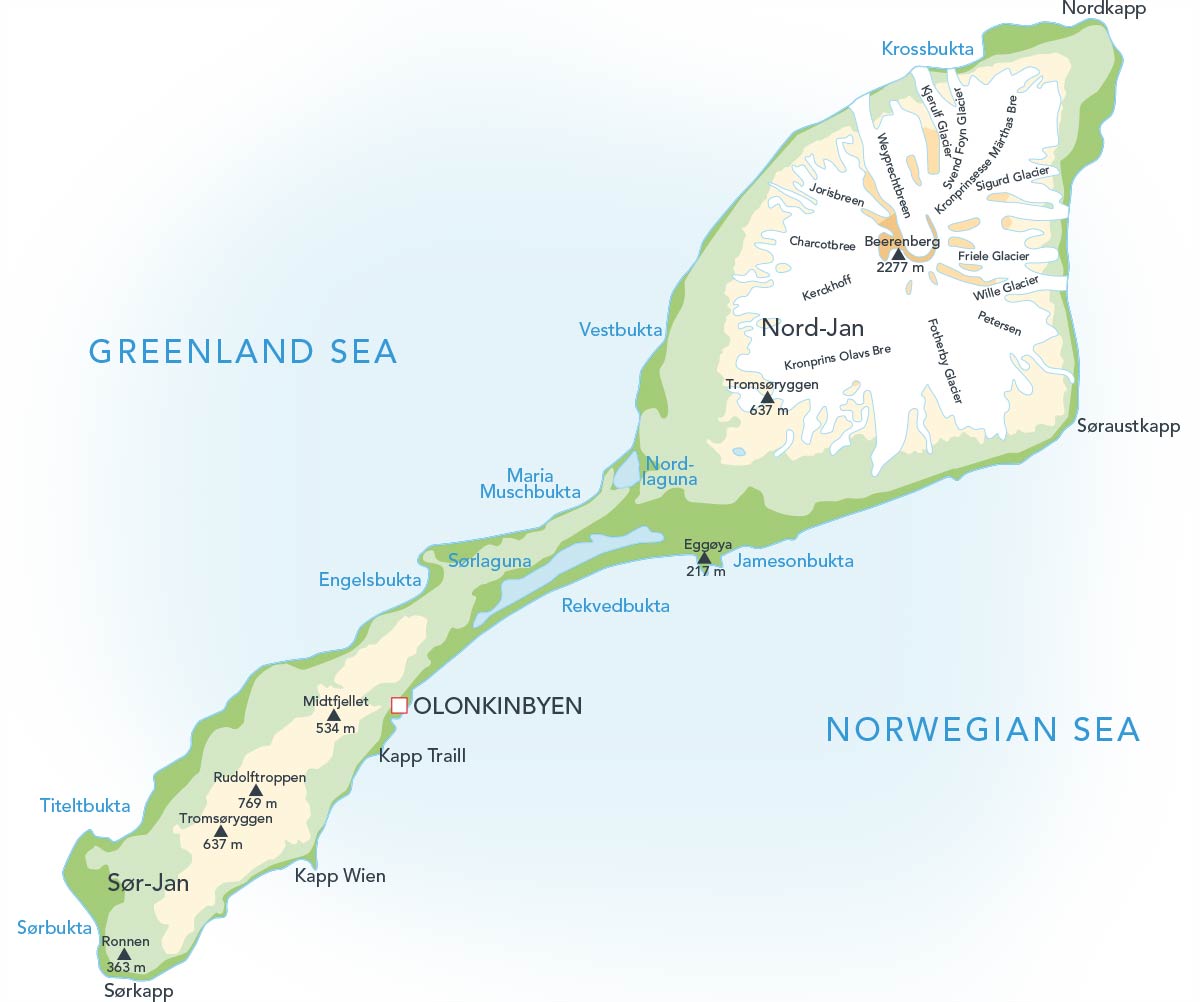
An Island Characterized by Dramatic Landscapes, Including Rugged Mountains and Glaciers
Stretching 55 km (34 mi) From Southwest to Northeast, the narrow volcanic island of Jan Mayen encompasses an area of 373 Km² (144 Sq Mi) and is divided into two distinct regions: Nord-Jan in the northeast and Sør-Jan in the southwest. These two regions are connected by a 2.5-kilometer-wide isthmus. The island is dominated by the towering Beerenberg volcano, which stands at 2,277 meters (7,470 feet) and is the northernmost active volcano in the world.
The larger Nord-Jan is defined by the presence of this imposing volcano, which is covered in glaciers. In contrast, Sør-Jan is much flatter and lacks the glaciation found in the north. The highest point in this region is Rudolftoppen, which reaches 769 meters (2,523 feet). This part of the island is home to the settlement of Olonkinbyen, where the island’s inhabitants live and work.
The High-Flying Wildlife of Jan Mayen
Jan Maven is a haven for seabirds. While the island’s volcanic and glacial terrain limits wildlife, the island’s cliffs are home to large colonies of Atlantic puffins, guillemots, and northern fulmars, which take advantage of the island’s undisturbed cliffs to breed and nest. The island’s surrounding waters are also home to various marine mammals, such as harbor and bearded seals, along with Humpback and Minke whales, which thrive in the nutrient-rich waters brought by the Gulf Stream.
Forecast for Today and Every Day: Cloudy
Despite its Arctic location, Jan Mayen experiences relatively mild seasonal temperature variations, with summer temperatures peaking around 43°F (6°C) in August and winter lows reaching approximately 25°F (-4°C) in March. The island’s most notable climate feature is its consistent cloud cover, which results in very little sunshine, even during the polar day when the sun remains above the horizon. The island’s deep snow cover prevents the development of permafrost, making the terrain unique compared to other polar regions. This consistent snow, combined with the polar climate, makes Jan Mayen an intriguing place for meteorological study, with the staff at the station regularly releasing radiosondes and conducting weather observations.
| AVERAGE HIGH | AVERAGE LOW | PRECIPITATION | |
|---|---|---|---|
| January | 28°F (-2°C) | 23°F (-5°C) | 2.99 in (76 mm) |
| February | 27°F (-3°C) | 21°F (-6°C) | 2.52 in (64 mm) |
| March | 25°F (-4°C) | 19°F (-7°C) | 2.60 in (66 mm) |
| April | 32°F (0°C) | 23°F (-5°C) | 2.28 in (58 mm) |
| May | 36°F (2°C) | 30°F (-1°C) | 2.17 in (55 mm) |
| June | 39°F (4°C) | 36°F (2°C) | 1.89 in (48 mm) |
| July | 43°F (6°C) | 39°F (4°C) | 1.65 in (42 mm) |
| August | 43°F (6°C) | 39°F (4°C) | 2.40 in (61 mm) |
| September | 39°F (4°C) | 36°F (2°C) | 2.40 in (61 mm) |
| October | 36°F (2°C) | 30°F (-1°C) | 3.15 in (80 mm) |
| November | 32°F (0°C) | 27°F (-3°C) | 3.03 in (77 mm) |
| December | 28°F (-2°C) | 23°F (-5°C) | 3.15 in (80 mm) |